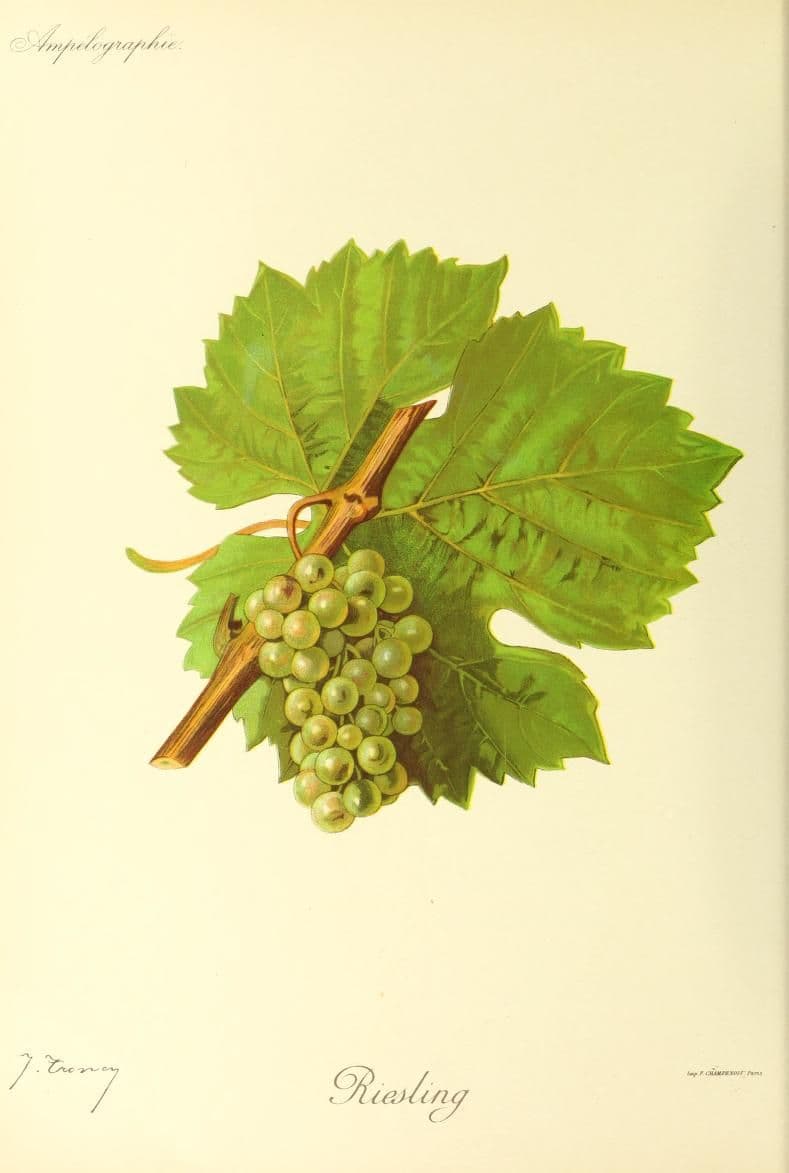
Riesling
Germany made Riesling sweet and immortal. The Clare Valley made it bone dry — and then changed how the world seals white wine.
The conviction
Most wine styles are inherited. Australian Riesling’s was decided. Where Germany built the grape’s fame on sweetness — sugar balancing that electric acid — the Clare Valley took the same grape and fermented it to nothing: bone dry, austere at first sip, all lime juice and wet slate, built to outlive the decade. It wasn’t a compromise with the climate or an accident of the market. It was a conviction — that Riesling without sugar has nowhere to hide, and doesn’t need one.
Drunk young, a Clare Riesling is a knife. Given ten years, it performs the same trick as Hunter Semillon — toast and honey and lime marmalade arriving from nowhere — while the acid keeps it standing at twenty.
Rhine grape, German hands
Riesling is the Rhine’s grape, documented there since the fifteenth century, and it came to South Australia with the same Silesian families who planted the Barossa in the 1840s. They carried it into the high country — the Clare and the Eden Valley, where altitude buys the cool nights the grape demands — and for more than a century it was Australia’s most planted white, the default glass before Chardonnay swaggered in. The accent changed along the way: German settlers, Australian sunlight, and a market that wanted its wine dry produced a style that exists nowhere in Germany.
Typical styles, not lab values — Australia lives at the left-hand edge
swipe to explore →
The screwcap rebellion
Riesling’s other Australian legacy is the top of the bottle. In 2000, a band of Clare Valley producers, tired of watching pristine Rieslings ruined by faulty corks, bottled their flagship wines under screwcap — then a seal associated with the cheapest plonk on the shelf. It was a genuine commercial risk, taken collectively, and it worked. New Zealand followed within a year; within a decade the screwcap was the default seal for quality white wine across both countries. The world’s wine drinkers can thank a valley of Riesling makers for the near-extinction of cork taint in their whites.
It was the right grape to gamble on. Nothing exposes a flawed seal faster than a wine this transparent — and nothing rewards a perfect one better than a Riesling quietly building its lime-and-toast future for fifteen years under sterile aluminium.
The cold-country map
Beyond the two valleys, Australian Riesling is a map of cold corners. Great Southern — the vast, remote region on Western Australia’s south coast — makes perhaps the country’s most delicate versions in its Porongurup and Mount Barker sub-districts. Henty, in Victoria’s windswept far south-west, is colder still: its Rieslings are featherweight, piercing and criminally underpriced. And Tasmania adds the island’s signature: purity, florals, and acid that needs no argument.
Five regions, one conviction. If you think you don’t like Riesling, it’s usually the sugar you don’t like — and Australia already removed it.
In the glass
Year one — pale silver-green
Year four — lime blossom
Year ten — lime marmalade, toast
Year twenty — deep gold, honeyed
Where to taste Riesling
SA · the heartland
Clare Valley
Two and a half hours north of Adelaide and a world apart: a quiet, limestone-carved landscape where Riesling achieves a crispness and longevity that rivals the best of Germany's Mosel.
Wine tours in Clare ValleySA
Eden Valley
The high country above the Barossa floor, sitting 400 to 500 metres above sea level: Eden Valley is where the same families who built Shiraz empires on the flats come to grow Riesling of piercing, mineral intensity.
Wine tours in Eden ValleyWA
Great Southern
Western Australia's largest and most diverse wine region: the Great Southern stretches from the south coast to the ranges inland, producing Riesling, Shiraz, and Cabernet across five distinct sub-regions that between them cover almost every cool-climate style the state can offer.
Wine tours in Great SouthernVIC
Henty
Victoria's most southerly and most underexplored wine region: Henty sits in the windswept Western District where the Southern Ocean influence produces Riesling, Pinot Noir, and Chardonnay of genuine cool-climate finesse from a handful of committed producers.
Wine tours in HentyTAS
Tasmania
Australia's island wine state sits in the Roaring Forties, where cool maritime air and ancient dolerite soils produce sparkling wines, Pinot Noir, and Chardonnay that have earned their place on every serious wine list in the country.
Wine tours in TasmaniaReading about wine is the rehearsal. The tasting room is the show.
Browse every wine tour region