Pinot Noir
Pinot Noir punishes the wrong site and transfigures the right one. Australia found its right ones at the bottom of the map.
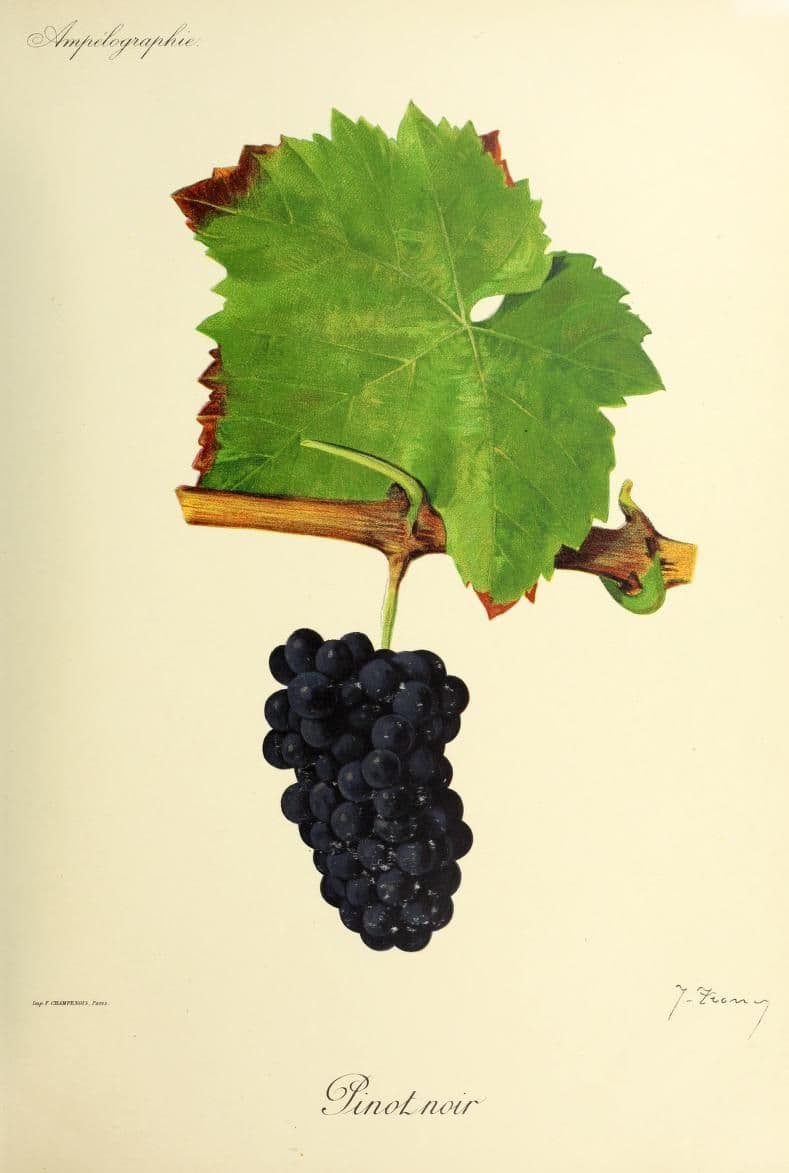
A grape that must be frightened
Plant Pinot Noir somewhere warm and easy and it makes wine like a shrug — pale, jammy, instantly forgettable. The grape only says anything interesting when the season scares it a little: when ripening takes so long, and runs so close to autumn’s edge, that every berry arrives with something to prove. Burgundy learned this over a thousand years. Australia learned it in about forty — mostly by planting Pinot in the wrong places first.
The right places, it turns out, are the cold bottom edge of the map: Tasmania above all, and a string of southern mainland sites where ocean, altitude or plain latitude keep summer honest.
A thousand years of pedigree
Pinot is ancient — documented in Burgundy since the fourteenth century and almost certainly older, the parent (with the humble white grape Gouais Blanc) of Chardonnay itself. It is also famously unstable: the vine mutates so readily that Pinot Gris and Pinot Blanc are simply Pinot Noir that changed its mind about colour. That genetic restlessness is part of the charm and all of the trouble — thin skins, tight bunches, a talent for rot, and a flat refusal to make good wine in bulk.
Early Australian growers planted it in climates suited to Shiraz and watched it sulk for a century. The turn came in the 1970s, when a generation of small growers went looking for cold sites on purpose — the Yarra Valley’s revival vineyards first among them.
Every serious Australian Pinot site crowds the cold end of the map
swipe to explore →
The island advantage
Tasmania is the endgame. At forty-two degrees south, with the Southern Ocean running the air conditioning, the island gives Pinot the longest, coolest ripening arc in the country — and the grape repays it twice. The still wines carry bright cranberry and cherry fruit over fine, sappy tannins. And a large share of the crop never becomes red wine at all: it goes into Australia’s best traditional-method sparkling, where Pinot’s job is structure, scent and the colour of dawn.
The mainland answers in accents. Mornington Peninsula, sea on three sides, makes the silkiest, most perfumed style. Geelong is windier and wilder, its Pinot darker and more savoury. The Macedon Ranges— the coldest wine region on the mainland — runs closest to Tasmania’s nerve, and the Adelaide Hills proves altitude can do the work of latitude.
What nervous tastes like
Good Australian Pinot smells before it tastes: red cherry, cranberry, dried rose, something faintly like the forest floor after rain. On the palate it should feel light and move heavy — silk with intent. Whole-bunch fermentation, where stems go in with the fruit, adds a peppery, sappy edge you’ll either adore or argue about. Either way, it is the opposite of the big Australian red, and the surest sign the country’s wine map has more than one pole.
In the glass
Tasmania — bright cranberry
Mornington — red cherry
Yarra — darker plum edge
With age — dried rose, earth
Where to taste Pinot Noir
TAS · the heartland
Tasmania
Australia's island wine state sits in the Roaring Forties, where cool maritime air and ancient dolerite soils produce sparkling wines, Pinot Noir, and Chardonnay that have earned their place on every serious wine list in the country.
Wine tours in TasmaniaVIC
Mornington Peninsula
Ringed by two bays and the Southern Ocean, the Mornington Peninsula is where Melbourne's winemakers built a cool-climate world 90 minutes from the CBD: the closest thing Victoria has to Burgundy by the sea.
Wine tours in Mornington PeninsulaVIC
Yarra Valley
An hour from Melbourne's CBD and Victoria's oldest wine country: the Yarra Valley's cool Burgundian climate produces Pinot Noir and Chardonnay that have made it one of the most seriously watched regions in the country.
Wine tours in Yarra ValleySA
Adelaide Hills
Cool air, eucalyptus forests, and elevation: the Adelaide Hills is where South Australia's winemakers come when they want to grow something the valley floor simply can't give them.
Wine tours in Adelaide HillsVIC
Macedon Ranges
The highest and coolest wine region in Victoria's central ranges, rising above 700 metres on the Great Dividing Range: the Macedon Ranges produces Pinot Noir, Chardonnay, and traditional method sparkling wine at an elevation that tests vines and rewards patience.
Wine tours in Macedon RangesVIC
Geelong
Ringed by Port Phillip Bay and the Surf Coast, Geelong is Victoria's most underrated wine region: a diverse landscape of volcanic plains, limestone ridges, and coastal slopes producing Pinot Noir, Chardonnay, and Shiraz within 75 minutes of Melbourne.
Wine tours in GeelongReading about wine is the rehearsal. The tasting room is the show.
Browse every wine tour region