Pinot Gris
also answers to Pinot Grigio
Gris or Grigio is not a translation problem — it’s a style declaration. Mornington reads it one way, the King Valley the other.
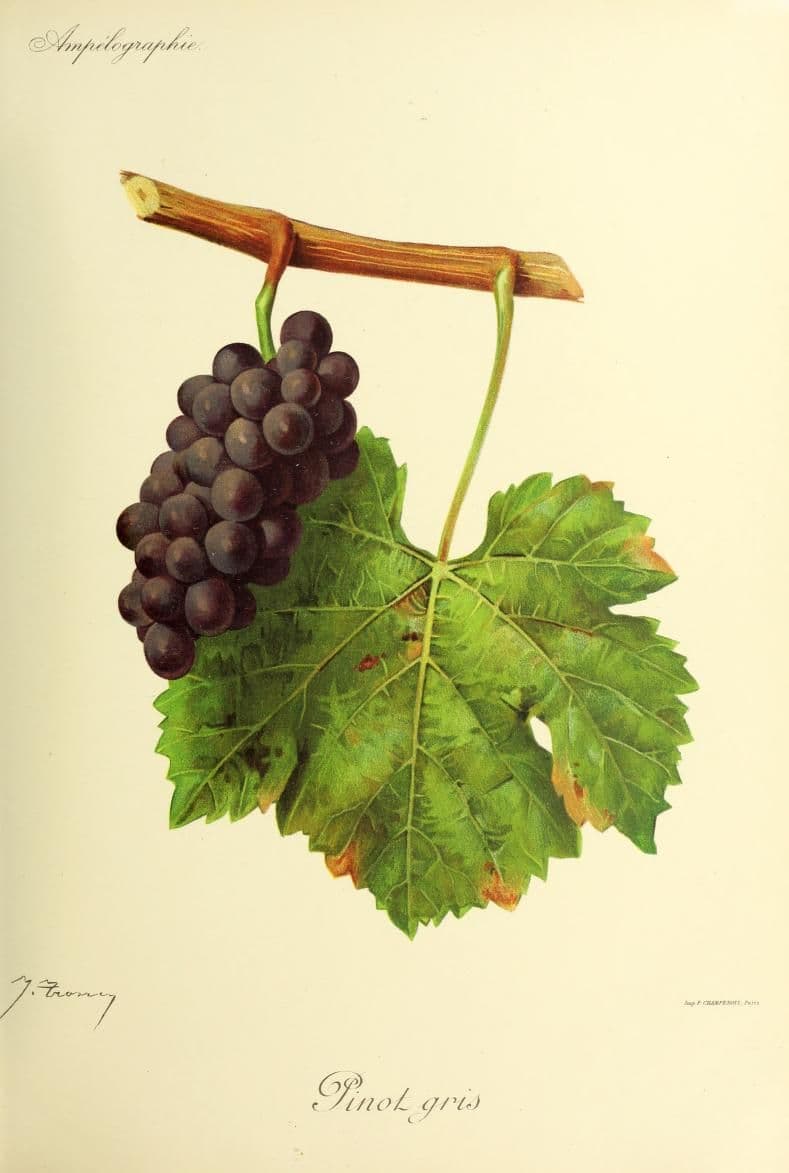
A grape with two passports
Walk any Australian bottle-shop aisle and you’ll find the same grape wearing two names, sometimes two shelves apart. Pinot Gris and Pinot Grigio are not different varieties, not clones, not marketing inventions of rival companies — they are one grape with two passports, French and Italian, and in Australia the choice of name is a declaration of intent. Gris promises Alsace: ripeness, texture, perfume. Grigio promises the Veneto: pale, brisk, gone before the plates are cleared. The drinker who learns to read the word learns more from it than from most back labels.
Pinot Noir’s grey child
The grape itself is a colour mutation of Pinot Noir — that genetically restless vine throwing off a version whose berries ripen not black but a dusky grey-pink. (Gris is simply French for grey; look at the 1901 plate above and the name explains itself.) It carried the Pinot temperament with it: a preference for cool places, modest yields, and a tendency to lose its acid quickly in the heat — which is why its Australian strongholds are the same cold corners its dark parent chose.
The promise of
GRIS
Alsace’s accent. Picked riper, sometimes touched by oak or lees: ripe pear, honeysuckle, a faint copper blush, real weight on the tongue. A white wine for a duck course.
Mornington reads it this way
The promise of
GRIGIO
The Veneto’s accent. Picked early and bottled bright: pale, crisp, dry, nashi pear and citrus, made to disappear cold on a warm afternoon without asking for attention.
The King Valley reads it this way
Same grape. Same vineyards, often. The word on the label is a promise about style — Australia is one of the few places that lets the maker choose it.
How the two accents settled here
Mornington Peninsula made the French reading its own. Sea-cooled and Pinot-obsessed in both colours, the peninsula treats Gris seriously — riper picking, barrel and lees work, wines with the weight to hold a main course — and its best are the country’s benchmark. The King Valley tells the other story: settled by Italian tobacco-farming families who turned to vines in the 1980s, it reads the grape in its ancestral accent — Grigio, bright and dry, alongside the Prosecco that made the valley famous.
The Adelaide Hills and Tasmania round out the map, both cool enough to keep the grape’s spine intact — Tasmania’s versions in particular carry an acid line the mainland envies.
Reading the glass
Expect nashi pear, apple skin and citrus from a Grigio, served hard-cold; expect ripe pear, honeysuckle and a silky mid-palate from a Gris, served a few degrees warmer, and don’t be alarmed by a faint copper tint — those grey-pink skins show through in the ripest versions, and it’s a feature, not a fault. If a label refuses to commit to either word, the wine usually sits somewhere between the two promises. Somebody at the winery argued about it; the argument is the style.
In the glass
Grigio — pale, crisp, early-picked
Between the styles — straw
Gris — ripe pear, weight
Full gris — faint copper blush
Where to taste Pinot Gris
VIC · the heartland
Mornington Peninsula
Ringed by two bays and the Southern Ocean, the Mornington Peninsula is where Melbourne's winemakers built a cool-climate world 90 minutes from the CBD: the closest thing Victoria has to Burgundy by the sea.
Wine tours in Mornington PeninsulaVIC
King Valley
A narrow Alpine valley three hours northeast of Melbourne where the Brown family's Dal Zotto and a community of Italian-heritage winemakers have turned Prosecco, Sangiovese, and Nebbiolo into the story that defines modern King Valley.
Wine tours in King ValleySA
Adelaide Hills
Cool air, eucalyptus forests, and elevation: the Adelaide Hills is where South Australia's winemakers come when they want to grow something the valley floor simply can't give them.
Wine tours in Adelaide HillsTAS
Tasmania
Australia's island wine state sits in the Roaring Forties, where cool maritime air and ancient dolerite soils produce sparkling wines, Pinot Noir, and Chardonnay that have earned their place on every serious wine list in the country.
Wine tours in TasmaniaReading about wine is the rehearsal. The tasting room is the show.
Browse every wine tour region