Mataro
also answers to Mourvèdre · Monastrell
Grenache and Shiraz get top billing in the blend. Mataro is the old bush vine doing the quiet structural work underneath, and it’s just as old, just as overlooked, and just as good on its own.
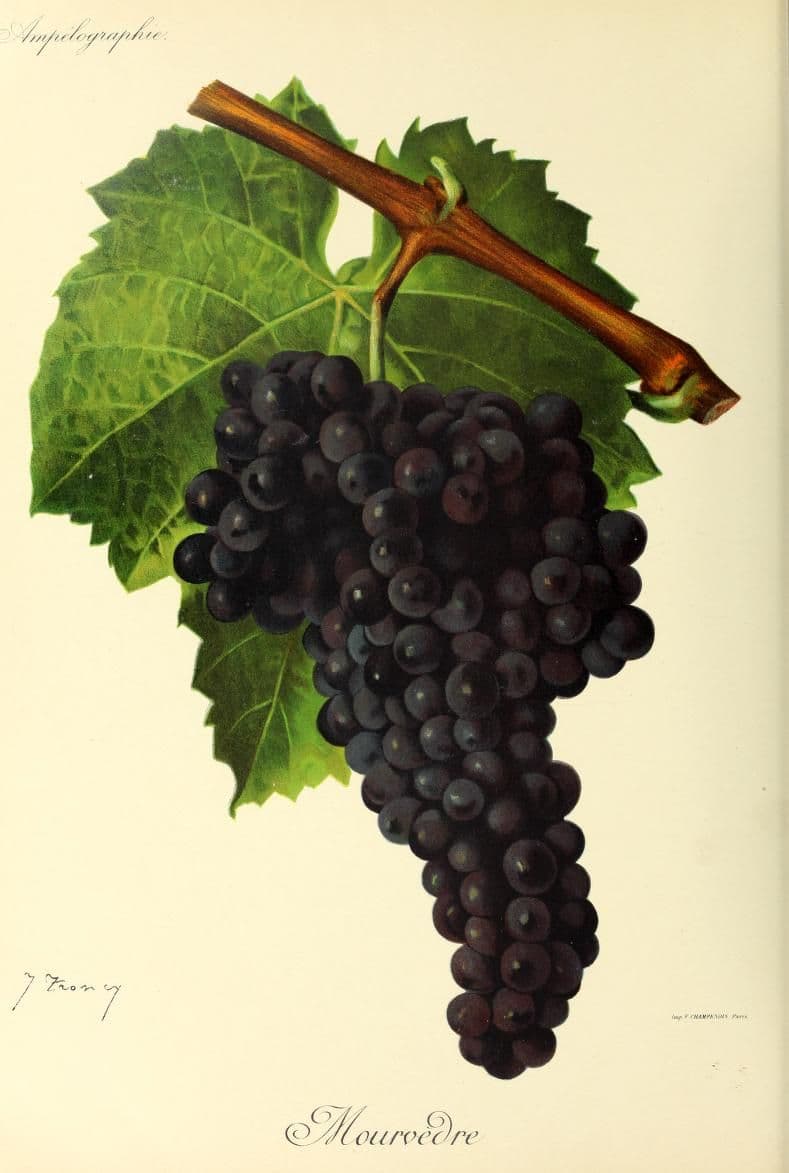
The grape that never gets top billing
Say “GSM” to anyone who drinks Australian red wine and they’ll picture Grenache and Shiraz: bright fruit, dark spice, the two grapes that give the blend its personality. Mataro is the M, always listed last, frequently in smaller type, and in the oldest bottlings not named on the label at all. It has been doing exactly the same structural work as its more famous blend-mates for well over a century, entirely without credit.
One grape, three names, none of them famous
Mataro is Australia’s name for a grape most of the world calls Mourvèdre (its French identity, centred on Bandol in Provence) or Monastrell, its original Spanish name, where it’s the dominant variety of regions like Jumilla and Yecla. Genetic studies trace it to Spain’s eastern coast, and it reached South Australia in the same wave of 1840s plantings that brought Grenache, both grapes chosen not for fine wine ambitions but because they could survive the colony’s heat and thrive without irrigation.
Like Grenache, most of that nineteenth-century Mataro went into fortified wine for decades, and like Grenache, the old bush vines that survived Australia’s twentieth-century fashion swings (including the 1985 Vine Pull Scheme that claimed so much old Shiraz) turned out to be sitting on something increasingly rare: genuinely old-vine Mourvèdre, a category most of the world has far less of than it once did.
Illustrative label conventions, not literal historical labels
swipe to explore →
What the third grape actually does
In a blend, Mataro brings savoury, gamey, almost meaty depth and a firm structural backbone: the grape that stops a Grenache-Shiraz pairing from being all bright fruit and no spine. It typically makes up the smallest share of a GSM by volume, which is exactly why it’s so easy to overlook and so noticeable the moment it’s missing.
Bottled alone, old-vine Barossa Mataro is a different animal entirely: dense, dark, full of black olive and dried herb notes, with a savoury intensity that rewards food and patience in roughly equal measure. It is not a crowd-pleaser in the way Grenache is. It is, for the people who seek it out, one of the more distinctive drinking experiences in the country.
Where the bush vines survived
The Barossa Valley holds the oldest, most storied blocks, planted alongside the same-era Grenache that made the region famous for old-vine reds. McLaren Vale runs a close second, its own nineteenth-century plantings surviving on the same logic: dry-grown, low-yielding, too stubborn to die and too unfashionable to replace, until fashion finally caught up.
Order a straight Mataro at a cellar door and you’re very often tasting the oldest vines on the property, no matter what else is planted around them.
In the glass
Young: dense, savoury, dark plum
Old bush vine: meat, black olive
Five years: game, dried fig
Old bottle: leather, forest floor
Where to taste Mataro
SA · the heartland
Barossa Valley
One of the world's great Shiraz regions: a wide, sun-drenched valley 70km north of Adelaide where third-generation families still hand-prune 160-year-old vines and lunch means three hours minimum.
Wine tours in Barossa ValleySA
McLaren Vale
Thirty-five minutes south of Adelaide, McLaren Vale is where the Fleurieu Peninsula meets the sea: maritime air, ancient almond trees, and Shiraz vines that have been working this red clay since the 1850s.
Wine tours in McLaren ValeReading about wine is the rehearsal. The tasting room is the show.
Browse every wine tour region