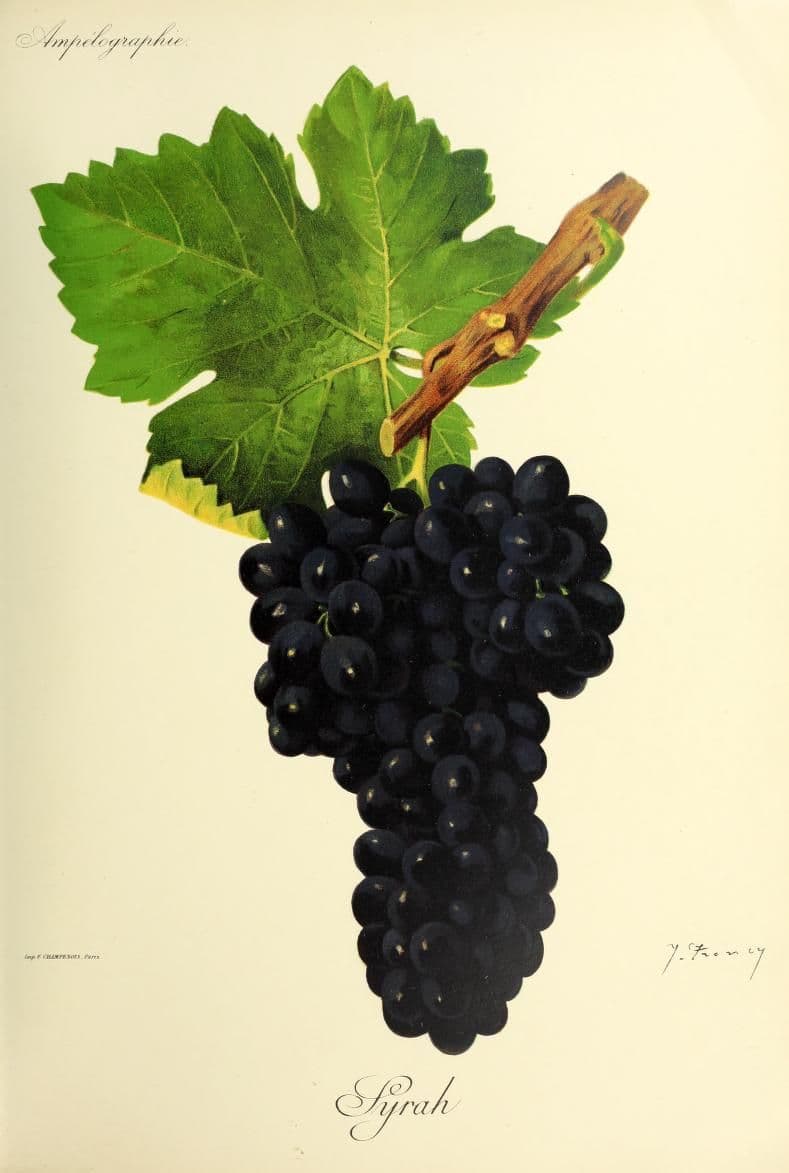
Shiraz
also answers to Syrah
France invented the grape. Australia kept the vines alive.
The vines that outlived France
In the 1870s a root louse the size of a pinhead ate its way through the vineyards of Europe. Phylloxera killed the Rhône’s Syrah, Burgundy’s Pinot, nearly all of it — and the cure, grafting European vines onto resistant American roots, saved the continent’s wine but ended its oldest plantings. When French growers replanted, they started the clock again from zero.
The clock in the Barossa Valley never stopped. Shiraz planted there by Silesian and English settlers in the 1840s is still fruiting — ungrafted, on its own roots, some of it worked by the sixth generation of the same family. If you want to stand in front of a living Syrah vine older than any in France, you don’t go to Hermitage. You drive an hour north of Adelaide.
Not from Shiraz
The romantic story says the grape came from Persia — carried west from the city of Shiraz by crusaders, or east by ancient traders, depending on who’s pouring. It is almost certainly false. DNA profiling in 1998 settled the parentage: Syrah is the child of two obscure French varieties, Dureza and Mondeuse Blanche, and its home is the northern Rhône. How an unremarkable pair produced the grape of Hermitage is one of wine’s better accidents.
Where the Australian name came from is genuinely contested. Busby’s catalogue spelled it “Scyras”; colonial growers wrote Sycras, Ciras and Shiraz within a generation. Whether that was phonetic drift or a deliberate nod to the Persian legend, nobody can prove. What’s certain is that by the 1860s Australia had its own word, and it stuck.
Each band is one season’s growth — wide in the kind years, narrow in the hard ones. The dark ring is 1985, the year the chainsaws came.
1843 — The core — planted at Langmeil
Shiraz goes into Barossa dirt from cuttings of the 1832 Busby collection. The vines are still producing — believed among the world’s oldest.
1877 — Phylloxera devours Europe
France loses nearly everything; Syrah survives only grafted onto American roots. Look at this ring: nothing happens. That is the point.
1899 — South Australia seals the border
Strict vine quarantine keeps phylloxera out of the state — permanently. The rings just keep coming.
1985 — The scar — the Vine Pull Scheme
A government subsidy pays growers to rip out “unfashionable” old Shiraz. Whole nineteenth-century blocks are lost; the survivors become sacred.
2009 — The Old Vine Charter
The Barossa starts certifying vines by generation — Old, Survivor, Centenarian and, at 125+ years, Ancestor.
Now — The bark — still growing
Ungrafted, dry-grown, hand-worked. Roughly 183 rings and counting — more than any Syrah left standing in France.
Ring pattern illustrative — a reading of the story, not a measured core sample
What the Barossa did with it
The Barossa’s luck was threefold. South Australia’s vine quarantine, enforced from the 1890s, kept phylloxera out — it has never entered the state. The valley’s dry summers meant vines were grown unirrigated and low to the ground, tough as mallee. And for most of the twentieth century Barossa Shiraz was unfashionable, destined for fortified wine and cheap blends, so nobody bothered ripping it out to plant something trendier. Obscurity preserved it.
Almost. In 1985 the South Australian government, facing a grape glut, paid growers to pull vines out. Whole blocks planted in the nineteenth century went to the chainsaw before anyone thought to count what was being lost. The shock of it produced the modern old-vine movement: the Barossa now certifies its vines by age — Old, Survivor, Centenarian, Ancestor — the last for vines of 125 years or more. It reads like a war memorial, and in a sense it is.
Neighbouring Eden Valley, higher and cooler, kept its own share of ancient plantings — Henschke’s Hill of Grace vineyard, planted in the 1860s, is the most photographed block of Shiraz on Earth.
One grape, six accents
Australian Shiraz is not one wine. The Barossa floor gives the archetype: opaque, plush, black fruit and dark chocolate, tannins like velvet upholstery. Drive forty minutes south-east and McLaren Vale turns the same grape maritime — blue fruit, liquorice, a saline edge off the gulf.
In Heathcote, Shiraz grows on 500-million-year-old Cambrian soil the colour of rust, and the wines are deep, savoury and mineral. The Hunter Valley— the grape’s other nineteenth-century stronghold — makes a medium-weight, earthy style that ages into leather and spice. And in the cool Grampians, Shiraz smells of cracked black pepper: the compound is rotundone, it forms in cool ripening seasons, and this corner of Victoria has it in higher concentration than almost anywhere.
Same grape. Six postcodes. That’s the whole argument for touring.
In the glass
Barossa, young — opaque violet-black
McLaren Vale — dark plum
Ten years on — garnet rim
Old Hunter — brick and leather
Where to taste Shiraz
SA · the heartland
Barossa Valley
One of the world's great Shiraz regions: a wide, sun-drenched valley 70km north of Adelaide where third-generation families still hand-prune 160-year-old vines and lunch means three hours minimum.
Wine tours in Barossa ValleySA
Eden Valley
The high country above the Barossa floor, sitting 400 to 500 metres above sea level: Eden Valley is where the same families who built Shiraz empires on the flats come to grow Riesling of piercing, mineral intensity.
Wine tours in Eden ValleySA
McLaren Vale
Thirty-five minutes south of Adelaide, McLaren Vale is where the Fleurieu Peninsula meets the sea: maritime air, ancient almond trees, and Shiraz vines that have been working this red clay since the 1850s.
Wine tours in McLaren ValeVIC
Heathcote
A long, narrow ridge of ancient Cambrian greenstone running north through central Victoria: Heathcote's 510-million-year-old soils produce Shiraz of a depth and complexity that has made it one of the most talked-about red wine regions in the country.
Wine tours in HeathcoteNSW
Hunter Valley
Two hours north of Sydney and Australia's oldest wine region: the Hunter Valley is where Semillon was turned into something utterly unique, and where weekends from the city have been a ritual since the 1960s.
Wine tours in Hunter ValleyVIC
Grampians
In the shadow of the Grampians ranges in western Victoria, one of Australia's most dramatic wine landscapes produces Shiraz and Riesling with a wild, spicy character that has earned serious attention from wine lovers who make the trip to find it.
Wine tours in GrampiansReading about wine is the rehearsal. The tasting room is the show.
Browse every wine tour region