Marsanne
The Rhône’s Marsanne nearly vanished from its own homeland, and the largest single planting left anywhere on Earth is a century-old block in Victoria’s Goulburn Valley.
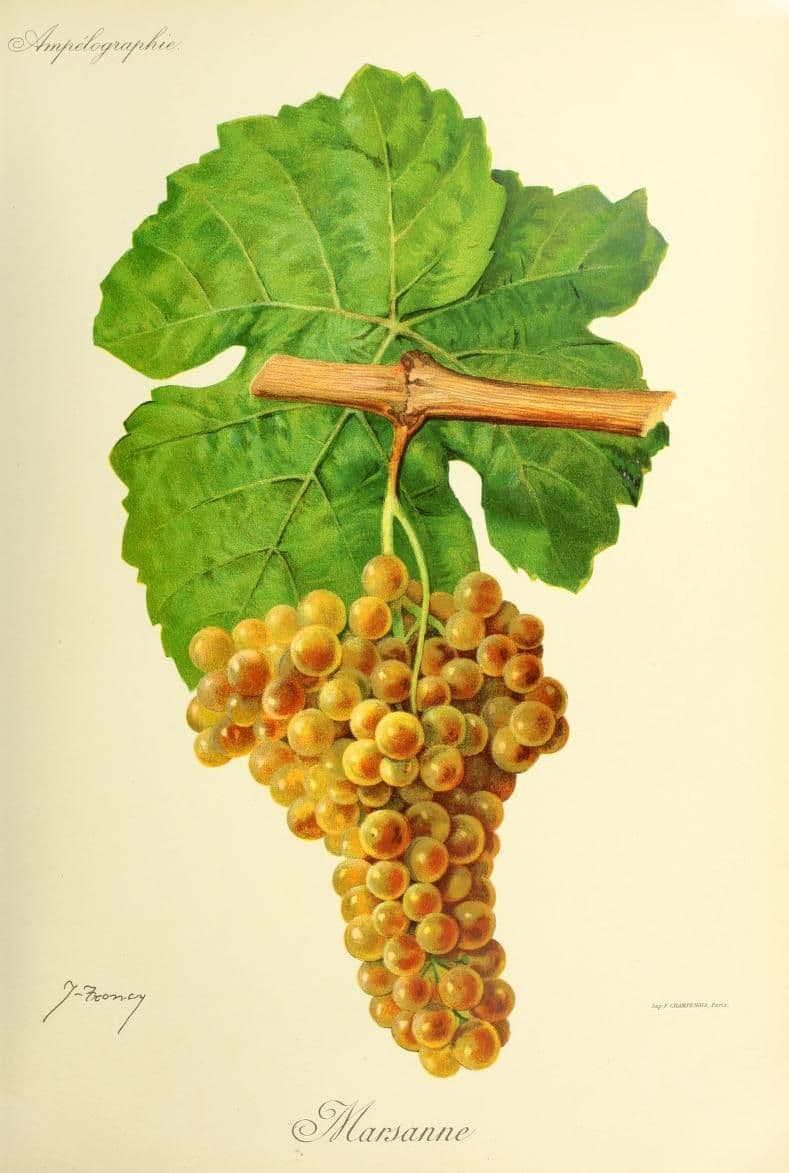
The largest planting on Earth, by not moving
A single block of Marsanne in Victoria’s Goulburn Valley, planted well over a century ago and never pulled out, is understood to be the largest continuous planting of the variety anywhere in the world. It didn’t earn that title by expanding. Almost everywhere else, growers pulled Marsanne out faster than anyone replanted it, and the Victorian block simply stayed exactly where it was.
A grape the Rhône stopped believing in
Marsanne is native to France’s Northern Rhône, historically central to white Hermitage and Crozes-Hermitage, blended with the more aromatic Roussanne to round out the variety’s naturally broad, sometimes blunt character. Through the twentieth century, as Rhône growers increasingly favoured Roussanne’s more immediately expressive perfume, Marsanne’s plantings shrank steadily, not through any single crisis, but through a slow, decades-long drift away from a variety that takes a genuinely long time to show what it’s capable of.
The Victorian planting, sitting continuously producing while its French counterparts were being grafted over to more fashionable grapes, quietly outlasted the trend rather than following it.
Relative index illustrating the trend, not a precise hectare count
swipe to explore →
A grape that punishes impatience
Young Marsanne is genuinely unremarkable: pale, waxy, faintly honeysuckle, easy to dismiss as simple. Given five to ten years it transforms almost completely: beeswax, toast and dried apricot develop, and old-vine examples from a block old enough to have survived a century of fashion swings can carry a depth that few other white grapes manage. That slow reveal is very likely the exact reason it fell out of favour: modern wine markets reward immediacy, and Marsanne offers the opposite.
A quiet Australian original
Beyond the Goulburn Valley, the Yarra Valley and Geelong both grow small amounts, usually in a white Rhône-style blend with Viognier. Nowhere in Australia treats it as a headline variety, and that suits a grape whose entire modern reputation rests on one century-old block that simply refused to disappear.
In the glass
Young: shy, waxy, closed
Five years: honeysuckle arriving
A decade on: beeswax, toast
Old vine: deep gold, marmalade
Where to taste Marsanne
VIC · the heartland
Goulburn Valley
The broad, warm valley of the Goulburn River in central Victoria: Goulburn Valley is Marsanne and Shiraz country, home to some of the oldest planted Marsanne vines in the world and a winemaking tradition that stretches back to the 1860s.
Wine tours in Goulburn ValleyVIC
Yarra Valley
An hour from Melbourne's CBD and Victoria's oldest wine country: the Yarra Valley's cool Burgundian climate produces Pinot Noir and Chardonnay that have made it one of the most seriously watched regions in the country.
Wine tours in Yarra ValleyVIC
Geelong
Ringed by Port Phillip Bay and the Surf Coast, Geelong is Victoria's most underrated wine region: a diverse landscape of volcanic plains, limestone ridges, and coastal slopes producing Pinot Noir, Chardonnay, and Shiraz within 75 minutes of Melbourne.
Wine tours in GeelongReading about wine is the rehearsal. The tasting room is the show.
Browse every wine tour region