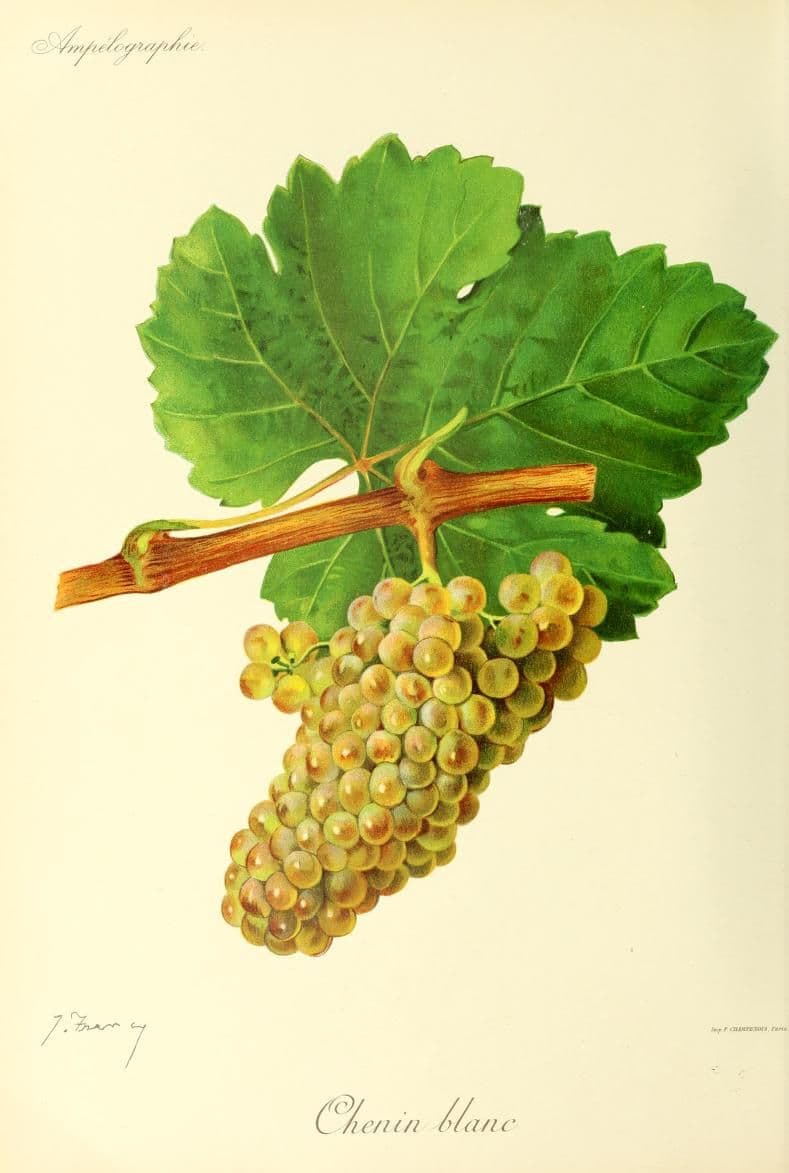
Chenin Blanc
also answers to Pineau de la Loire
It arrived with the Swan River Colony, carried the West’s wine industry for a century, and nearly vanished for being useful instead of famous.
The colonist
Chenin Blanc has been in Western Australia almost as long as Western Australia has existed. Vine cuttings reached the Swan River Colony within its first years in the 1830s, and the Swan Valley — flat, river-fed, ferociously hot — became the colony’s vineyard. For the century that followed, Chenin was its quiet engine: blended, fortified, bottled under other names, rarely credited. It was the grape that worked. And the fate of grapes that work, in wine as in offices, is to be taken entirely for granted.
The Loire’s workhorse-genius
At home in the Loire, Chenin is France’s great shape-shifter — bone-dry in Savennières, honeyed and immortal in Vouvray, sparkling in Saumur, botrytised in the Layon. One grape, every register, held together by a single trait: acidity that simply does not surrender. That trait is what made it the perfect colonist. Plant most white grapes on a 40-degree Swan Valley January and they collapse into flab; Chenin ripens fat with sunshine and still finishes with a snap. The French use its acid to age wine for fifty years. The West Australians used it to survive the weather. Same tool, different war.
Mean summer temperatures approximate — the point is the spread, not the decimals
swipe to explore →
Nearly lost to fashion
What heat couldn’t do, fashion nearly did. When Chardonnay arrived with its French name and its marketing tailwind, Chenin’s acreage was pulled or grafted across the state, and the Swan itself dwindled to a fraction of its old vineyard. The survivors are the story now: gnarled old blocks on the valley floor and down the coastal plain at Peel, where one famously stubborn producer spent decades proving that old-vine Chenin, barrel-aged and left alone, becomes something the Loire would recognise — baked apple, quince, lanolin and honey over that unkillable spine. The bottles cost a fraction of their French cousins because fame never arrived. Buy them before it does.
Where it stands now
The Swan remains the heartland — drink it there in a courtyard it helped pay for, alongside the valley’s fortifieds. Peel keeps the benchmark old-vine style. And further south, Margaret River gives the grape a milder, greener reading, mostly in crisp blends where its acid sharpens softer company. A new generation of West Australian makers has started bottling Chenin straight and saying its name loudly — skin contact, wild ferments, the works. The colonist that carried the West for a century is finally getting the byline.
In the glass
Young — green apple, chalk
Five years — quince arriving
Twelve years — lanolin, honey
Old Swan — baked apple, gold
Where to taste Chenin Blanc
WA · the heartland
Swan District
The Swan Valley immediately northeast of Perth is where Western Australian wine began: a flat, hot river valley where Chenin Blanc, Verdelho, and fortified wines have been made by the same families since the 1830s, and where a day from the city still delivers genuine cellar door character.
Wine tours in Swan DistrictWA
Peel
South of Perth along the Peel Inlet and Mandurah coast, the Peel wine region is one of WA's smallest and least-known: a warm, flat coastal plain where a small number of producers grow Shiraz, Verdelho, and Chenin Blanc with the same unhurried confidence as the landscape itself.
Wine tours in PeelWA
Margaret River
At the southwestern tip of Western Australia, Margaret River is a surf coast turned wine country: where Cabernet Sauvignon and Chardonnay grow to world standard between the Indian Ocean and the Southern Ocean.
Wine tours in Margaret RiverReading about wine is the rehearsal. The tasting room is the show.
Browse every wine tour region