Cabernet Sauvignon
Coonawarra’s terra rossa is a strip of crumbled red loam over soft white limestone — and it makes Cabernet like nowhere else on Earth.
The dirt is the celebrity
Most famous wine places are famous for a building, a family, a slope with a château on it. Coonawarra is famous for dirt. A strip of crumbly red loam — roughly twenty kilometres long, about two wide — laid over soft white limestone in the flat far south-east of South Australia, three hundred-odd kilometres from anything you’d call a hill. Winemakers argue about property boundaries here the way they argue about vintages elsewhere, because a few metres decides whether your vines sit on terra rossa or off it.
On it, Cabernet Sauvignon makes wine with a signature you can pick blind: blackcurrant, dried bay, a dusty fine-grained tannin, and a eucalyptus-mint note that no other Cabernet on Earth carries quite the same way.
An accident, twice over
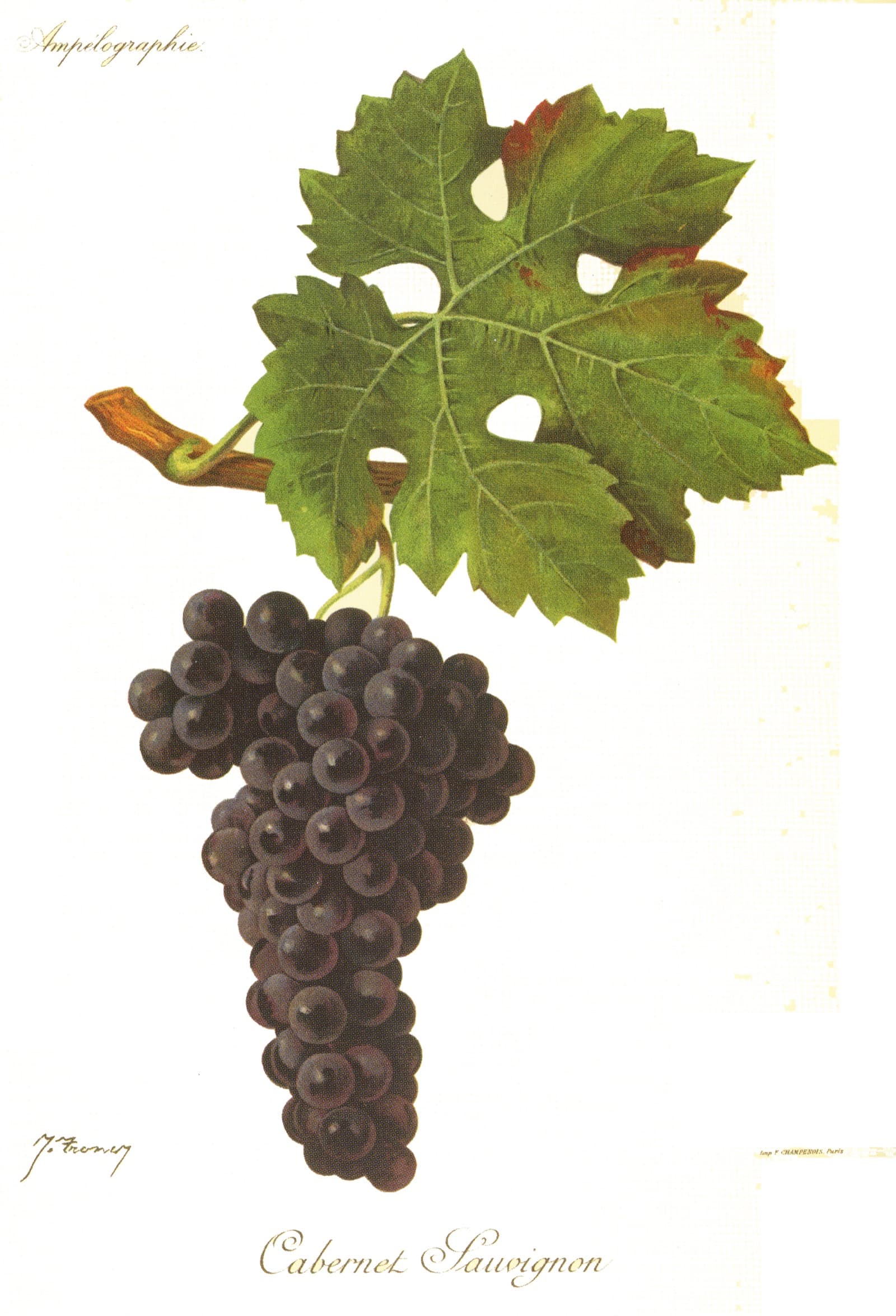
The grape itself is an accident. DNA work at UC Davis in 1996 revealed Cabernet Sauvignon to be a chance crossing of Cabernet Franc and — improbably — Sauvignon Blanc, somewhere in seventeenth-century Bordeaux. A red grape with a white parent: the small, thick-skinned, seed-heavy berries it inherited are why the wine is so dark, so tannic, and so capable of outliving the people who made it.
Its Australian chapter begins with the early colonial collections, but the Coonawarra chapter starts in 1890, when the Scottish pastoralist John Riddoch subdivided his land at Penola into a fruit colony and planted vines on the red ground. The venture nearly died with him; for half a century the region survived on brandy and bulk wine, its Cabernet unfashionable and its distance from everywhere unforgiven. The rediscovery came in the 1950s and 60s, when winemakers realised the cool, flat, red-dirt paddocks had been quietly making claret-weight wine all along.
The entire famous strip is roughly 20 km long and about 2 km wide
swipe to explore →
How half a metre of loam works
The recipe has three parts. The terra rossa itself — iron-stained, free-draining, friable — is only about half a metre deep: enough to feed a vine, not enough to spoil it. Beneath it lies a hard calcrete crust that roots must crack through, a struggle that keeps vigour in check. And under that, metres of soft marine limestone — an old seabed — holding a shallow, pure water table the roots can reach in a dry summer.
Restraint above, insurance below. The vine is never drowned and never desperate, and Cabernet — a grape that sulks when overwatered and toughens when stressed — finds the exact middle it likes. Add a climate cooler than the Barossa (the Southern Ocean is just over the horizon) and ripening stretches long and slow, which is where the fine tannin and the bay-leaf perfume come from.
The same limestone country runs north through Wrattonbully and Padthaway— Coonawarra’s quieter siblings, where the dirt is closely related and the cellar doors are blissfully uncrowded.
The other Cabernet capital
Two thousand seven hundred kilometres west, Margaret River makes the other great Australian Cabernet — and the argument between them is the best rivalry in Australian wine. Margaret River’s gravelly loams and Indian Ocean air give a wine less about blackcurrant and more about dark cherry and graphite, with a fragrant, almost Bordeaux polish. Coonawarra answers with structure and that unmistakable mint.
For a cooler, leafier take, the Yarra Valley’s Cabernet is the historic sleeper — it was the backbone of the valley’s nineteenth-century fame. Taste all three in a season and you’ll never need the word “terroir” explained again.
In the glass
Coonawarra, young — cassis black
Margaret River — dark cherry
A decade in — cedar rim
Old bottle — dried leaf, brick
Where to taste Cabernet Sauvignon
SA · the heartland
Coonawarra
A narrow strip of terra rossa soil over limestone in South Australia's far southeast: Coonawarra's famous red earth produces Cabernet Sauvignon of a precision and longevity that has earned it a place among the world's great red wine regions.
Wine tours in CoonawarraWA
Margaret River
At the southwestern tip of Western Australia, Margaret River is a surf coast turned wine country: where Cabernet Sauvignon and Chardonnay grow to world standard between the Indian Ocean and the Southern Ocean.
Wine tours in Margaret RiverSA
Wrattonbully
North of Coonawarra and still largely undiscovered: Wrattonbully grows Cabernet and Shiraz on terra rossa soils with slightly more warmth and depth than its famous neighbour, producing wines of serious weight that rarely carry the premium their quality deserves.
Wine tours in WrattonbullySA
Padthaway
Flat, fertile, and five hours southeast of Adelaide: Padthaway built its reputation quietly on large-scale Chardonnay and Shiraz that proved the Limestone Coast could produce serious wine long before Coonawarra got all the attention.
Wine tours in PadthawayVIC
Yarra Valley
An hour from Melbourne's CBD and Victoria's oldest wine country: the Yarra Valley's cool Burgundian climate produces Pinot Noir and Chardonnay that have made it one of the most seriously watched regions in the country.
Wine tours in Yarra ValleyReading about wine is the rehearsal. The tasting room is the show.
Browse every wine tour region