Tempranillo
Rioja’s grape ripens weeks ahead of Shiraz, and in the warm, dry Mediterranean climate of McLaren Vale, that head start turned out to be exactly the advantage Australia was looking for.
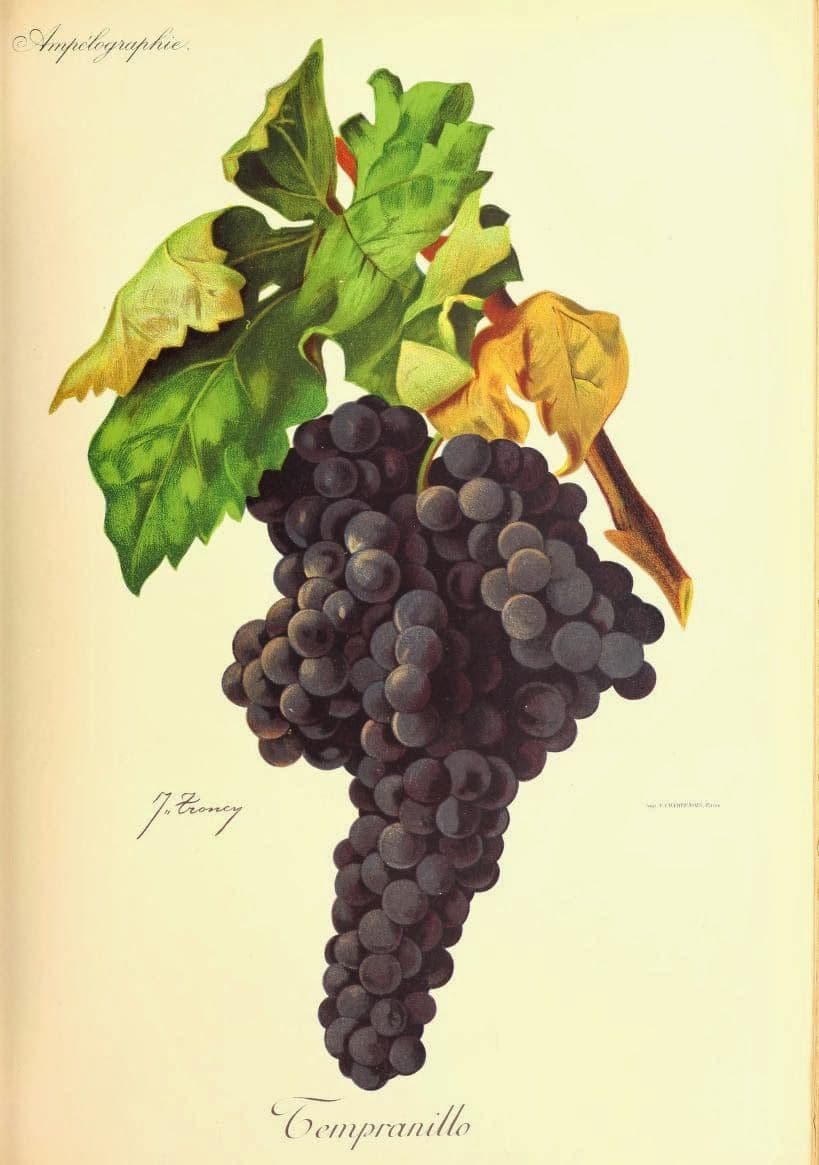
Named for time itself
Tempranillo takes its name from the Spanish temprano (early), and it is not a subtle head start. In its Rioja homeland the grape is routinely picked two to three weeks before neighbouring Garnacha, and when McLaren Vale growers began planting it in earnest in the 1990s and 2000s, that same early window turned out to solve a real problem: how to pick a serious red grape before the peak of a long, hot Mediterranean-climate summer does its damage.
A Spanish grape, an Australian import wave
Tempranillo’s arrival in Australia is inseparable from the broader “alternative varieties” movement of the 1990s: a deliberate push, led by growers and nursery importers frustrated with the country’s reliance on a handful of French grapes, to bring in varieties bred for climates that actually resemble large parts of South Australia. Rioja’s summers are hot and dry in exactly the way the Mediterranean basin’s are, which made Tempranillo one of the first, and still one of the most convincing, of the imports.
The timing mattered as much as the climate match. Growers weren’t just chasing a new flavour: they were solving a genuine viticultural problem, and a grape that finishes its ripening before the hottest weeks of the vintage is a grape that sidesteps sunburn, dehydration and the jammy over-ripeness that plagues late-picked reds in a heatwave year.
Typical McLaren Vale picking windows: vintages and sites vary
swipe to explore →
What the early pick buys you
Picked at the right moment, Tempranillo gives bright cherry and redcurrant fruit, a dusty, earthy undertone, and tannin that’s present but rarely aggressive, a red built for food rather than contemplation. It takes oak well without needing much of it, and it blends easily with Grenache and Shiraz for growers who want to hedge rather than commit outright, though the best examples now stand entirely alone.
The early ripening window is a double-edged tool: pick too early and the tannins are green and the wine tastes thin; the grape rewards a grower who watches it closely rather than one working to a fixed calendar date. That attentiveness is part of why it’s stayed a grower’s grape rather than a mass-market one.
Beyond the Vale
Heathcote’s ancient red Cambrian soils give Tempranillo real depth and minerality; the Adelaide Hills, cooler and higher, makes a more perfumed, lighter-framed style closer to a good Rioja Crianza; and King Valley and the Riverland both grow it at scale for easy-drinking, well-priced bottlings.
It is, in the end, a grape defined by a deadline it consistently beats, which is a strange thing to say about a wine, and exactly the point.
In the glass
Young: cherry, violet rim
McLaren Vale: dark berry, dust
Barrel-aged: tobacco arriving
Old Rioja style: leather, tawny edge
Where to taste Tempranillo
SA · the heartland
McLaren Vale
Thirty-five minutes south of Adelaide, McLaren Vale is where the Fleurieu Peninsula meets the sea: maritime air, ancient almond trees, and Shiraz vines that have been working this red clay since the 1850s.
Wine tours in McLaren ValeVIC
Heathcote
A long, narrow ridge of ancient Cambrian greenstone running north through central Victoria: Heathcote's 510-million-year-old soils produce Shiraz of a depth and complexity that has made it one of the most talked-about red wine regions in the country.
Wine tours in HeathcoteSA
Adelaide Hills
Cool air, eucalyptus forests, and elevation: the Adelaide Hills is where South Australia's winemakers come when they want to grow something the valley floor simply can't give them.
Wine tours in Adelaide HillsVIC
King Valley
A narrow Alpine valley three hours northeast of Melbourne where the Brown family's Dal Zotto and a community of Italian-heritage winemakers have turned Prosecco, Sangiovese, and Nebbiolo into the story that defines modern King Valley.
Wine tours in King ValleySA
Riverland
Five hundred kilometres of Murray River frontage and South Australia's highest-volume wine region: the Riverland is where affordable, reliable Australian wine begins, and where a growing number of producers are pushing far beyond that brief.
Wine tours in RiverlandReading about wine is the rehearsal. The tasting room is the show.
Browse every wine tour region