Grenache
also answers to Garnacha
For a century Grenache was fortified filler. The old bush vines of McLaren Vale — squat, dry-grown, untrellised — turned out to be treasure.
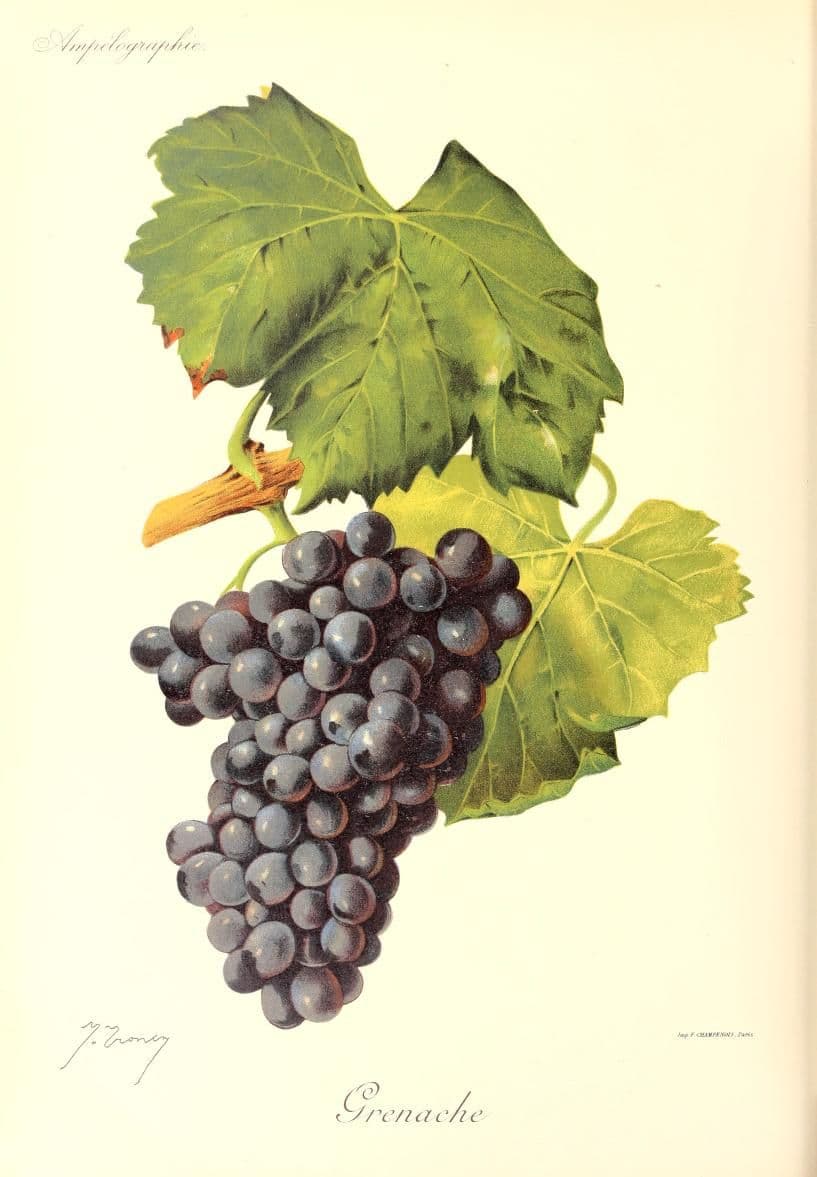
The inheritance nobody wanted
For most of the twentieth century, Grenache was what you grew when nobody was asking your opinion. It went into flagons, into fortifieds, into blends that never printed its name. The vines themselves — squat, head-trained bushes planted across McLaren Vale and the Barossa from the 1850s onward — were too unfashionable to replace and too stubborn to die. So they sat there, dry-grown and ignored, sinking their roots deeper by the decade.
Then Australian palates swung away from weight and toward perfume, and somebody looked again at what a 120-year-old bush vine actually produces: tiny crops of bright, fragrant, silk-textured red. The unwanted inheritance turned out to be the estate.
Spain’s great traveller
Grenache — Garnacha at home — is almost certainly Spanish, out of Aragón, and it colonised the warm Mediterranean rim centuries before it reached the southern hemisphere: Rioja, Priorat, and the whole sun-baked south of France, where it anchors Châteauneuf-du-Pape. It loves heat, shrugs at drought, and ripens late with sugar to spare — which is exactly why colonial South Australia, building an industry on fortified wine, planted it everywhere. The grape that powers Priorat’s intensity spent its first Australian century as tank filler. Wine has better comedians, but few better ironies.
Old bush-vine Grenache yields little and concentrates much — that scarcity is the style
swipe to explore →
What a bush vine buys you
A head-trained vine is a small tree. No posts, no wires, no drip line — just a gnarled trunk and a crown of arms, spaced wide so each vine drinks whatever the sky provides. It cannot be machine-harvested and it will never yield much, and both facts are the point: what survives is concentrated. McLaren Vale’s oldest Grenache blocks date from the nineteenth century, and the Barossa’s from the 1840s onward — among the oldest producing Grenache anywhere on Earth, phylloxera never having crossed the South Australian border.
The modern style honours the vine rather than the tank: picked earlier, fermented gently, sometimes with whole bunches, raised in old wood or concrete rather than new oak. The result sits closer to fine Pinot Noir than to the jammy warhorse the grape’s reputation promised — raspberry and red cherry, white pepper, a saline McLaren Vale edge, tannins like crushed silk.
Where the old vines live
McLaren Vale is the heartland and the style-setter, its sea-cooled hills now as associated with single-site Grenache as with Shiraz. The Barossa’s old blocks lean darker and fleshier, and the Clare Valley — better known for its Riesling — keeps a quieter tradition of perfumed, savoury Grenache from its warm valley floors. Out along the river, the Riverland holds surviving old plantings of its own, and its best growers are turning them into wines that embarrass the region’s bulk reputation.
Seek out the words bush vine and old vine on the label, and drink it a shade cooler than you would a Shiraz. The perfume does the rest.
For the producers and vintages actually worth seeking out, see our guide to McLaren Vale’s best Grenache and Fiano. And if the timing works, the region runs an entire festival around the grape each spring — see Grenache & Gourmet.
In the glass
Young — bright raspberry, translucent
In its prime — red cherry, spice
A decade on — dried strawberry
Old style — tawny, earthy edge
Where to taste Grenache
SA · the heartland
McLaren Vale
Thirty-five minutes south of Adelaide, McLaren Vale is where the Fleurieu Peninsula meets the sea: maritime air, ancient almond trees, and Shiraz vines that have been working this red clay since the 1850s.
Wine tours in McLaren ValeSA
Barossa Valley
One of the world's great Shiraz regions: a wide, sun-drenched valley 70km north of Adelaide where third-generation families still hand-prune 160-year-old vines and lunch means three hours minimum.
Wine tours in Barossa ValleySA
Clare Valley
Two and a half hours north of Adelaide and a world apart: a quiet, limestone-carved landscape where Riesling achieves a crispness and longevity that rivals the best of Germany's Mosel.
Wine tours in Clare ValleySA
Riverland
Five hundred kilometres of Murray River frontage and South Australia's highest-volume wine region: the Riverland is where affordable, reliable Australian wine begins, and where a growing number of producers are pushing far beyond that brief.
Wine tours in RiverlandReading about wine is the rehearsal. The tasting room is the show.
Browse every wine tour region