Fiano
An ancient Campanian grape with thick skins, stubborn acid and no thirst — planted in South Australia as a bet on the climate that’s coming.
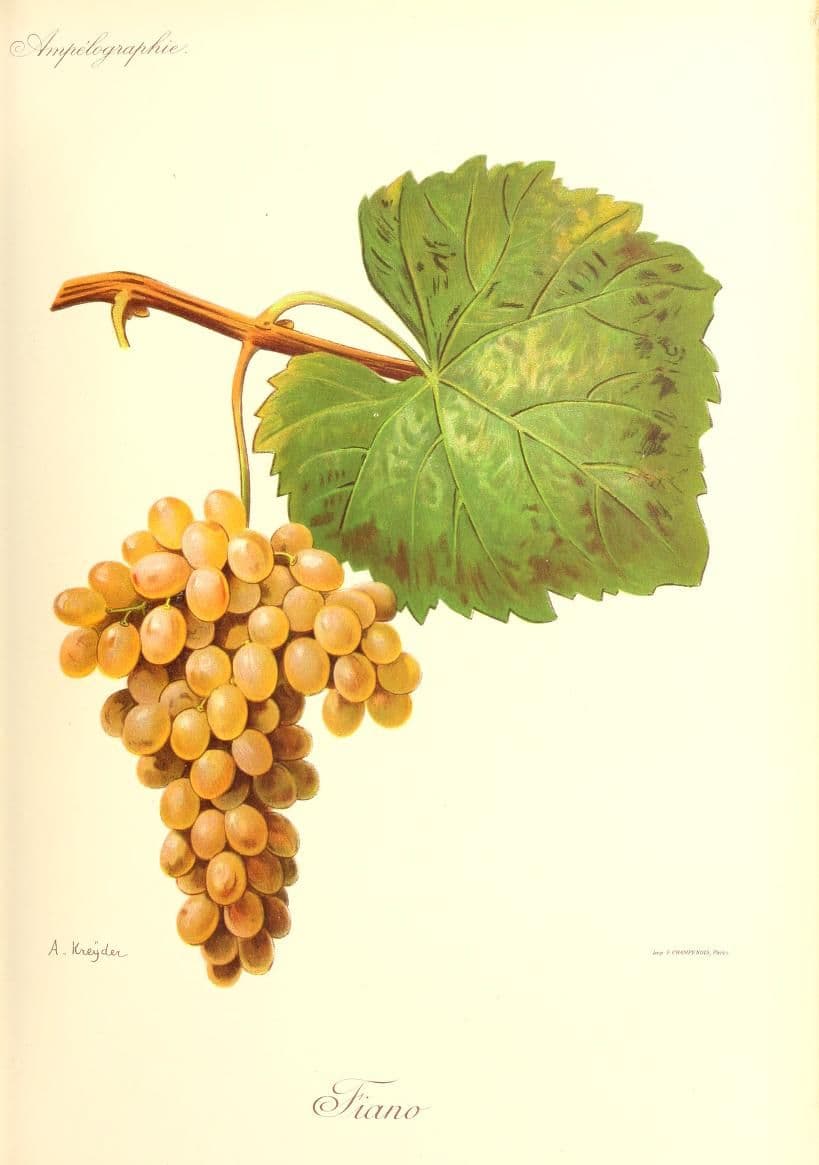
A bet on the weather
Every vineyard decision is a twenty-year bet on the weather, and the weather is changing the odds. When McLaren Vale growers began pulling out thirsty French whites in the early 2000s and grafting in an obscure grape from the hills behind Naples, it looked like a novelty. It was actuarial. Fiano is what two thousand years of Campanian summers produce: a white grape with thick, sun-proof skins, acid that refuses to quit in the heat, and no particular need for rain. Australia’s warm regions weren’t buying a curiosity. They were buying insurance.
The vine of the bees
Fiano is one of Italy’s ancient whites, grown around Avellino since at least Roman times — the story goes that its old Latin name, vitis apiana, means “vine of the bees”, because bees found its sweet, waxy berries irresistible. (Etymologies this charming are usually folk tales; this one is at least a very old folk tale.) It survived the centuries as a local specialty, nearly vanished in the twentieth century, and was rescued by Campanian producers who believed a grape that had outlasted Vesuvius deserved better than extinction. Australia’s plantings — first in the Vale in the early 2000s — are the newest chapter of a very long book.
Vitis apiana — “vine of the bees”, the Romans said: even the bees preferred it
swipe to explore →
What it tastes like
Fiano’s trick is texture. Where most warm-climate whites turn flabby, Fiano stays waxy and firm — pear skin, honeysuckle and dried herbs over a chalky, almost grippy palate, with hazelnut arriving as it ages. It can be made bright and early for the beach, or skin-contacted and lees-worked into something serious enough for the table. McLaren Vale’s versions lean golden and textural; up in the Adelaide Hills the cooler sites give a leaner, more citrus-drawn line. In the Riverina, where summer is not a season but a verdict, Fiano’s heat tolerance has made it the thinking grower’s white — proof the grape can carry quality at scale.
The Mediterranean turn
Fiano is the sharp end of a broader movement: Australian growers looking past France toward grapes bred for climates like ours — Vermentino, Nero d’Avola, Montepulciano, Tempranillo. It is the one that has moved fastest from experiment to conviction, and tasting it at a cellar door usually comes with the best kind of conversation: a grower explaining, over a cold glass, exactly what the next thirty years of Australian summer look like — and why this grape, of all of them, is ready.
In the glass
Young — straw, pear skin
A year on — honeysuckle
Textural style — hazelnut, wax
Aged — honey, dried herbs
Where to taste Fiano
SA · the heartland
McLaren Vale
Thirty-five minutes south of Adelaide, McLaren Vale is where the Fleurieu Peninsula meets the sea: maritime air, ancient almond trees, and Shiraz vines that have been working this red clay since the 1850s.
Wine tours in McLaren ValeSA
Adelaide Hills
Cool air, eucalyptus forests, and elevation: the Adelaide Hills is where South Australia's winemakers come when they want to grow something the valley floor simply can't give them.
Wine tours in Adelaide HillsNSW
Riverina
The vast irrigated flatlands of the Murrumbidgee River in southwestern NSW: the Riverina produces a staggering proportion of Australia's wine, and within that volume, some of the country's most extraordinary sweet wines from botrytis-affected Semillon that has no peer in the Southern Hemisphere.
Wine tours in RiverinaReading about wine is the rehearsal. The tasting room is the show.
Browse every wine tour region